

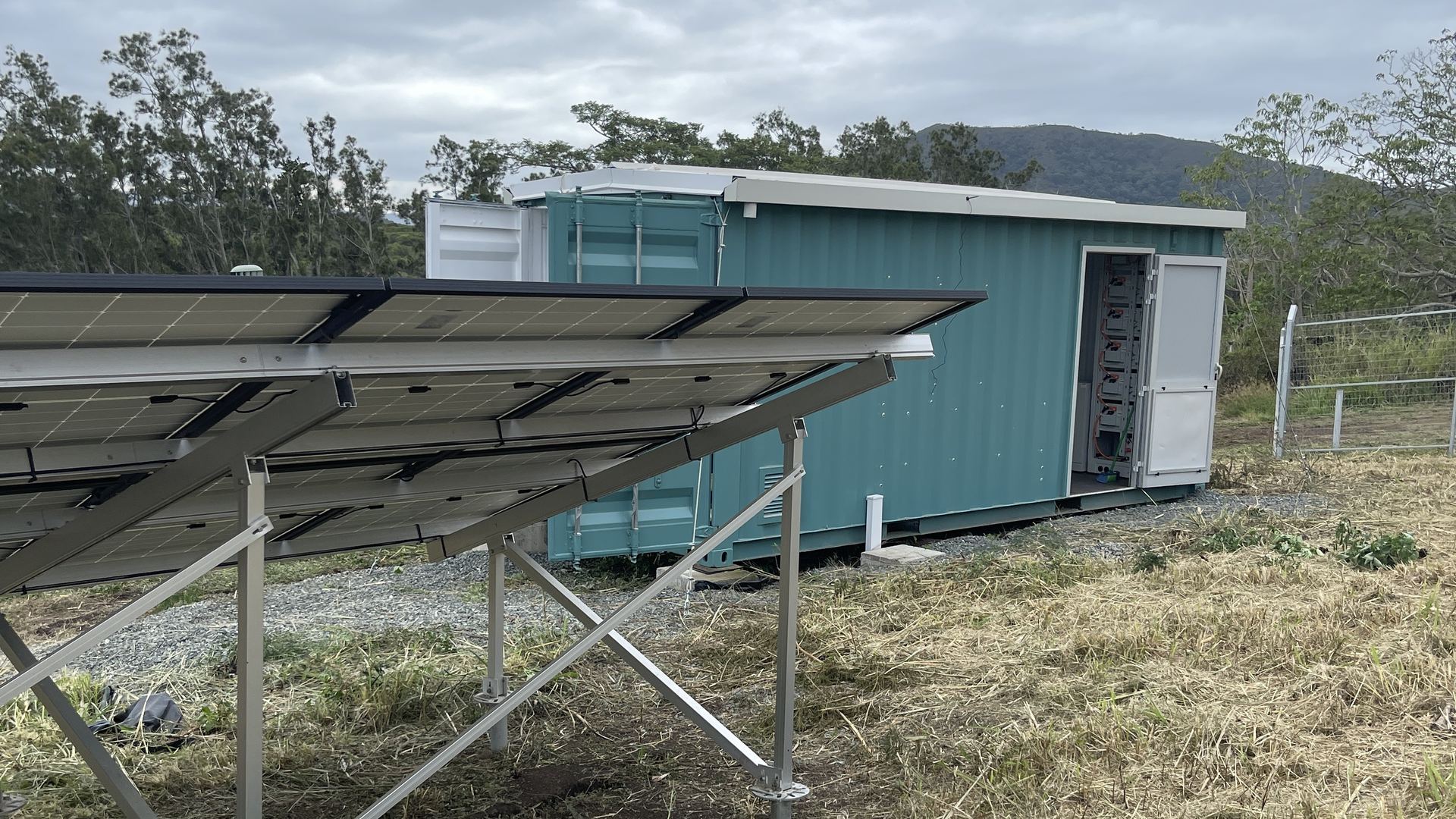
Lebris Peninsula — La Foa
Client: Town of La Foa
- Output
- 30–44 m³/d
- Energy
- 2.7 kWh/m³
- Solar
- 46 kWp
- 100% solar
- Lithium battery, 24 h autonomy
- No network required
Solar desalination · New Caledonia
100% solar seawater desalination stations, designed, installed and operated in New Caledonia.
The video
French audio · English subtitles.
The context
On remote sites, islands and communes of the North and the Pacific, access to drinking water is limited: salinised groundwater, no network, dependence on diesel generators.
Renewable Water NC brings a sustainable, self-sufficient answer: producing water on site, with the energy of the sun, with no fuel to ship in.
Coastal groundwater and wells become unfit for consumption.
Islets and remote sites are connected to neither water nor electricity.
Fuel to haul in, operating costs beyond your control, breakdowns and emissions.
The solution
A containerised station that turns seawater into fresh water, without network and without fuel. Designed, installed and operated by our teams in New Caledonia.
Danfoss iSave system: the concentrate's pressure is reused instead of being lost.
Specific consumption — best-in-class efficiency. Less energy per cubic metre, so fewer panels and lower cost.
Capacities of 5, 10, 25, 50, 100 and 300+ m³/day, sized to the real need.
Photovoltaic field and lithium battery. No grid connection required.
The unit arrives ready on site. Fast installation, small footprint.
Remote tracking of production and parameters, action before any breakdown.
Water compliant with domestic and community use, tested at the station outlet.
Photovoltaic panels guaranteed for 25 years, inverters 10 years. Premium components, chosen to last in a marine environment.
What sets us apart
We don't subcontract the energy, the water, or the operation. This end-to-end control is what lets us deliver on our numbers in the field.
Desalination and photovoltaics designed together, by the same team, from the study stage.
Not a catalogue figure: a result measured on our stations in service.
A New Caledonian SME, rooted in the South Province, that understands the constraints on the ground, locally and across the Pacific.
We remain responsible after commissioning. A single point of contact throughout the lifetime.

Operating cost
The upfront investment is only part of the equation. Over twenty years, it's the fuel that makes the difference.
Fuel avoided · 20 years
~49 million XPF
for a 40 m³/day station.
At project scale
up to 365 M XPF
of fuel avoided at the scale of Ouvéa.
At Taanlo, Renewable Water NC replaced a diesel generator with a 100% solar installation. Water production continues; the fuel bill stops.
Conservative estimate: fuel only, excluding engine maintenance, logistics and equipment renewal.
Our projects
Every site has its constraints. Here are two installations designed, delivered and operated by our teams.
Client: Town of La Foa

Clients: Enercal / Town of Poum
Television report
The Caledonia TV channel devoted a news segment (“Le JT”) to our solar desalination station on Taanlo Islet, commune of Poum. Report in French.
Source: Caledonia · Le JT — 2 min 43 · in French
Projects under way: Ouvéa (300 m³/d) and Tuvalu (320 m³/d, international tender).
Our method
Analysis of the need, the resource and the site. Sizing of the unit and the solar field.
Premium components, sourced and assembled. Indicative lead time: about 45 days.
RWNC team on site, 2 to 3 weeks of work, training of local operators.
Performance tests, handover of the works and delivery of complete documentation.
Frequently asked questions
Our photovoltaic panels are guaranteed for 25 years, with an estimated lifespan of up to 30 years; the inverters are guaranteed for 10 years. The reverse-osmosis desalination unit is designed for around 15 years of operation. Renewable Water NC handles operation and maintenance throughout that period.
Our stations are modular: from 5 to 300+ m³ of fresh water per day. Capacity is sized to the site's real need — from an isolated hamlet to an entire commune — and can grow by adding modules.
By default, our stations are 100% self-sufficient: photovoltaic field and lithium battery, with no connection required. A backup via generator or the electrical grid can be added at the design stage if the site requires it.
Yes. Our process turns seawater into drinking water with a desalination rate ≥ 99.8%, compliant with health standards. It can supply drinking water to remote sites, islands and communes anywhere in New Caledonia, including on the mainland (Grande Terre).
The lithium battery takes over, with 24 h of autonomy. In case of prolonged bad weather, a backup system (generator or grid) can be provided to guarantee continuous water production.
Our own teams. Renewable Water NC designs, installs and operates every station: a single point of contact throughout the lifetime, with 24/7 remote monitoring and action before any breakdown.
Seawater is forced at high pressure through membranes that retain the salt. Our energy-recovery system (Danfoss iSave) reuses the residual pressure instead of losing it, cutting consumption by nearly three times: 2.45 to 2.7 kWh per m³ of water produced.
Contact
Commune, operator, funder or private site: tell us about your water need and your site, and we'll come back to you with a first technical approach.
Eric Prous
Managing Director
34 rue Albert Schweitzer
BP 13208, 98800 Nouméa
New Caledonia
RIDET 1 493 031.002